
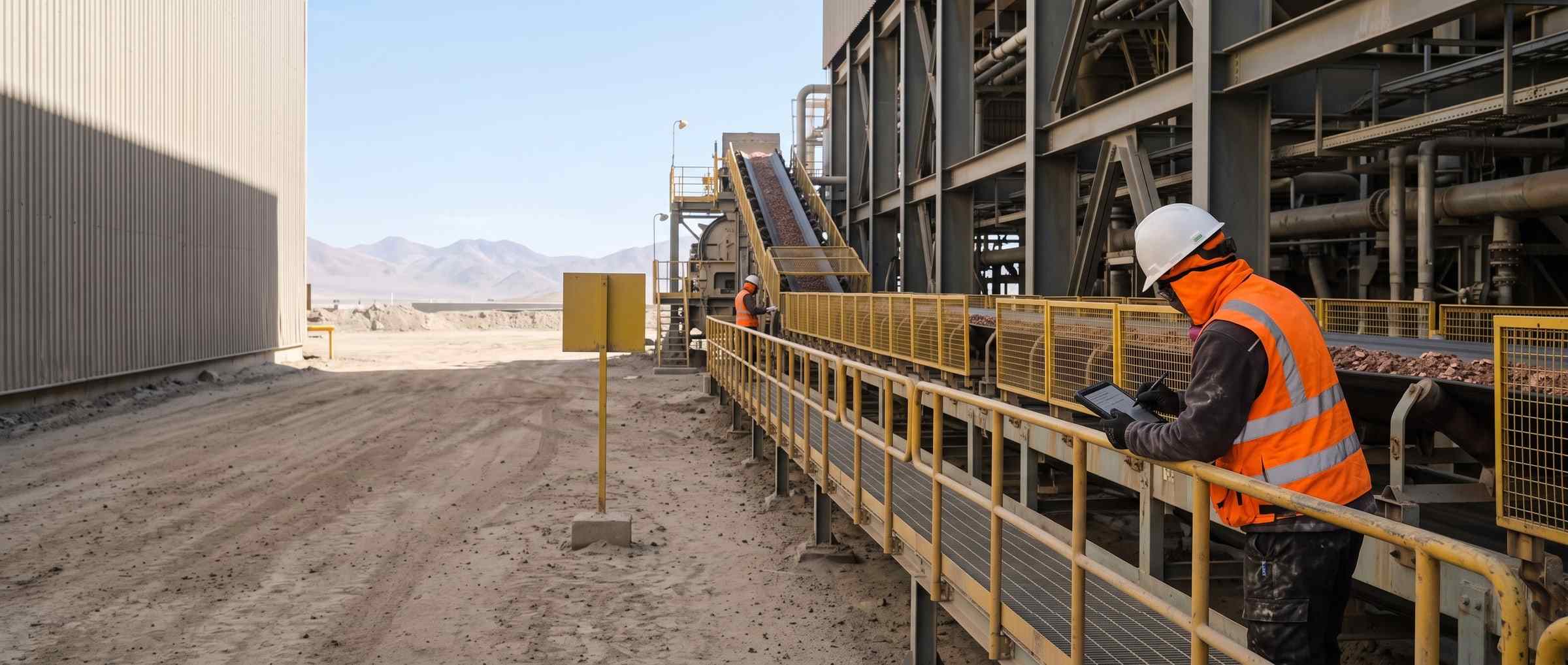
Industries · Mining
No signal at the site. No excuses when the regulator arrives.
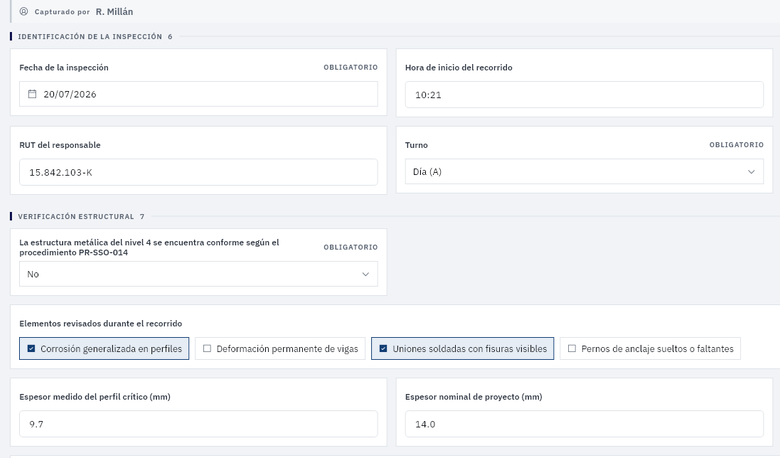
The form your site already uses, digitised exactly as it is. It gets filled with no coverage and every finding lands on the pit plan or on the mine level. The approval is signed afterwards, carrying the server’s timestamp: the seal is the server’s, so it needs a connection.
What happens today
- The pre-use check is filled in the truck, gets wet, and two weeks later nobody can find the one from the day that matters.
- The regulator’s observation is closed out the same day, but the photo that proves it is on the phone of someone who no longer works here.
- The monthly statistics required by article 71 are assembled by hand, chasing spreadsheets from every contractor, and filed on the 14th at eleven at night.
Five workflows, with the role that does them today
- 01
Open pit · benches, berms and waste dumps
- Who does it today
- The mine operations shift supervisor, on the opening round.
- What is left
- Every finding on the pit plan, with the bench as the level, and statistics per sector.
- 02
Underground · scaling and ground support condition
- Who does it today
- The area supervisor, heading by heading.
- What is left
- A record per heading with its expiry, on the multi-level map, and the heading’s file with its full history.
- 03
Concentrator plant · lockout permit
- Who does it today
- The maintainer and the crew, before touching crushing, milling or conveyors.
- What is left
- The permit digitised as it is, with the whole crew’s signatures traced on the spot, and the approval sealed by the server once there is a connection.
- 04
Tailings storage · dam operation inspection
- Who does it today
- The facility operator, every day.
- What is left
- Freeboard, pond, drainage and channels, with range validation on the reading and piezometers as fixed points.
- 05
Mobile equipment · pre-use check and equipment log
- Who does it today
- The haul truck, front loader or LHD operator.
- What is left
- A complete history per unit, exportable — which is what the regulator can ask for at any time.
What the regulation requires, and where it is stored
No program enforces D.S. 132. What a program can do is make sure the evidence exists, is dated, and does not have to be hunted for.
| What the regulation requires | What evidence PAIR produces |
|---|---|
| D.S. 132 art. 17 The SERNAGEOMIN Book The observations and corrective measures the Service enters in the Book must be carried out and answered within the period each entry sets. Failing to do so, or losing the Book, entitles the Service to impose penalties. | The history per heading and per installation, with what was answered to each observation and when, exportable as the PDF that accompanies the reply. |
| D.S. 132 art. 39 Start-of-shift verification At the start of the shift, every worker verifies that the equipment, machinery and control elements they are about to work with are in good order, and reports any defect immediately. | Pre-use check digitised as it is, filled with no signal, with history per unit and per heading. |
| D.S. 132 arts. 158, 159, 161, 162 Ground support and scaling Periodic inspection of drifts and review of shafts every six months at most. Access without scaling is forbidden. | A record per heading with its expiry, a multi-level map and a file per heading with its full history. |
| D.S. 132 art. 71 Monthly statistics The mining company compiles the monthly statistics and requests those of its contractors. Filed before the 15th of the following month, with the Regional Directorate. Forms E-100 (principal) and E-200 (contractor) are filed in SIMIN with ClaveÚnica. PAIR delivers the data; it does not file the submission. | Records export filtered by period and by contractor, with the national ID masked according to who exports. |
| D.S. 132 art. 410 Maintenance plan Up-to-date records that the regulator can request at any time. | A log per item: every unit, room or installation with its complete, exportable history. |
The bodies named are the regulators. PAIR neither represents them nor carries their endorsement.
What you start with
Not thousands of templates. A few, built for Chilean mine sites, used as they are or changed entirely. And if your site already has its own on paper, you upload the scan and it comes out identical.
- Berm, road and waste dump inspection, with the safety berm standard
- Scaling and ground support condition check per heading
- Six-monthly review of supported shafts
- Lockout and tagout permit for equipment intervention
- Conveyor belt inspection: idlers, splices, guards and stopping devices
- Pre-use check for haul truck, front loader and LHD
- Daily tailings facility inspection: freeboard, pond, drainage and channels
- High-potential incident report, article 77
Demo
Bring us a form from your site
A pre-use check or an inspection you use today: in thirty minutes you will see it digitised and filled from a phone, with no signal.
- Would you rather look at the plans first? See pricing.
- Still have questions? Check the FAQ.