

Industries · Real estate
The buyer signs the handover record. What it misses, after-sales never sees.
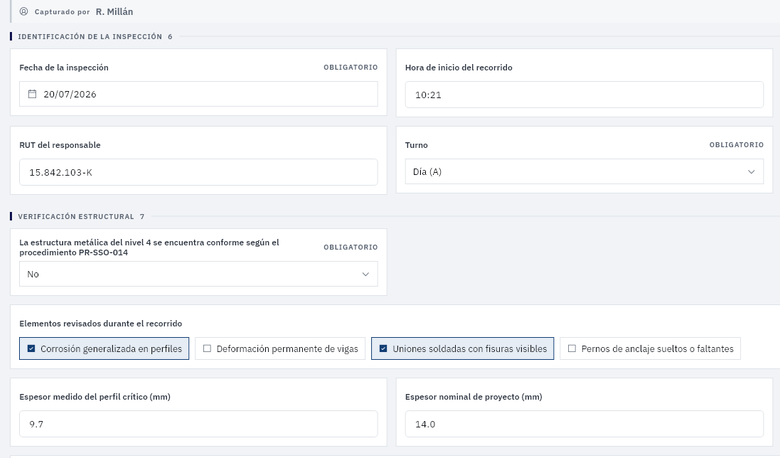
The handover record your company already uses, digitised exactly as it is, with its letterhead and its checkboxes. It gets filled inside the apartment, with the buyer alongside: every snag lands on the floor plan of the room it is in, the photo keeps its coordinate and the time it was taken, and the buyer signs on screen and takes the PDF away.
What happens today
- The buyer writes “unit 1204, main bathroom, bath seal” on the back of the record by hand and someone transcribes it two days later, in different handwriting. Sometimes nobody transcribes it.
- The photos of the three hundred snags are on the handover coordinator’s phone, with no unit number and no time.
- The leak complaint for 1204 arrives and the file is fourteen emails: who went, on what day, what the subcontractor repaired and whether the client signed off.
Five concrete jobs, with the role that does them today
- 01
Pre-handover · walking the building, floor by floor
- Who does it today
- The developer’s handover coordinator, walking with the contractor’s site manager.
- What is left
- Every snag on the apartment’s floor plan, in the room it is in, with its status painted on top. The re-inspection walks what is filtered, not the whole building.
- 02
The handover record, signed inside the apartment
- Who does it today
- The handover executive, with the buyer alongside and the key in hand.
- What is left
- The same record the company already uses, with its letterhead and its checkboxes, signed on screen by the buyer, who takes the PDF away that same day. The PDF is assembled with a connection, which is when the signature and the photographs go in.
- 03
After-sales: from the complaint to the owner’s sign-off
- Who does it today
- The after-sales technician in the field; the in-house crew or the subcontractor does the work.
- What is left
- The unit’s file assembled on its own — complaint, diagnosis, work order, repair and signed sign-off — exportable years later.
- 04
The round of the handed-over building, down to level −2
- Who does it today
- The concierge every day; the building administrator closes the month.
- What is left
- The round points on the floor plan of each level, with no signal in the basement, and the current certificate attached to its point with the renewal task open.
- 05
Move-in and move-out of the rented unit
- Who does it today
- The operations executive at the rental operator, or the broker managing the lease.
- What is left
- The side-by-side comparison: the same form at both ends, field against field, and the photo of the same wall months apart.
What the record has to withstand, and where that comes from
None of these regulations requires you to buy a program. What they set is what the record you already sign has to withstand: who signed, when, and who got to see the buyer’s national ID.
| What the regulation requires | What evidence PAIR produces |
|---|---|
| Law 19.799 arts. 3 and 5 Electronic signature and evidentiary value Acts signed with an electronic signature produce the same effects as those signed on paper, and the signature is treated as handwritten for all legal purposes. The date of a private electronic instrument, however, does not make proof on its own: the law requires an electronic timestamp from an accredited provider. | The buyer’s signature traced on screen over the record, with the document’s digital fingerprint and the capture time. It is a simple electronic signature: PAIR is not an accredited provider of advanced signature or of electronic timestamping. |
| Law 21.719 · Law 19.628 art. 2 f) and art. 3 c) The buyer’s national ID A name and a national identity card number make a person identifiable. Only data that are necessary, adequate and pertinent to the purpose may be processed. | The record carries the national ID because the sale deed asks for it; the list the plumbing subcontractor sees does not. Name and national ID masked according to who is looking, on export too. |
| Law 21.719 · Law 19.628 art. 14 quinquies Security, from 1 December 2026 Adopt security measures — the law names pseudonymisation and encryption — and prove their existence and their operation after an incident or in a judicial or administrative dispute. | An access and operations log over every handover record and every after-sales file: who opened it, who exported it and when. Proving means showing the log, not describing the policy. |
| Law 20.123, art. 183-E of the Labour Code Subcontracted work The principal company adopts the measures needed to protect the life and health of all workers on its works, company or site, whatever their dependency. | The subcontractor that walks into the building leaves its own record, separated by company, and the developer or the administrator keeps a single history for the property. |
The bodies named are the regulators. PAIR neither represents them nor carries their endorsement.
What you start with
These are the ones the developer or the building administrator already has on paper. You upload the scan and it comes out identical, with its letterhead and its checkboxes.
- Unit handover record, with meter readings and key handover
- Buyer’s snag list, room by room
- Pre-handover checklist floor by floor, before the buyer is invited
- Second handover record, when the snags were not closed on the first
- After-sales request and diagnostic visit
- Owner’s sign-off record after the repair
- Daily concierge round and incident log
- Maintenance control for lifts, pumps, generator set and fire main
- Move-in inventory for a rented unit and its move-out
Demo
Bring us your handover record
The handover record and the snag list you use today: in thirty minutes you will see them digitised and filled from a phone, with your own letterhead and your own checkboxes.
- Would you rather look at the plans first? See pricing.
- Still have questions? Check the FAQ.