
Solutions · Maintenance and assets
A machine does not stop for lack of a spare part. It stops because nobody knew it was due.
Every unit has its schedule and its date. The problem is never the schedule: it is that the date lives in a spreadsheet that gets opened late, and that what was done to the iron is spread between a folder, a chat and the memory of whoever was there that day. PAIR puts both things on the unit’s record.
What stops a scheduled maintenance from happening
- The schedule exists and so does the date, but they live in a spreadsheet that gets opened when somebody remembers. A unit can go twenty-nine days without maintenance and show up on no screen.
- When the machine fails, the first question is what was done to it and when. The answer is in three places and none of them is the unit.
- The machine goes out on loan with a photo and comes back with a dent. Without both ends of the same form, the conversation about who did it cannot be won.
Five things that change in the first month
- 01
The next date stops living in the spreadsheet
- Who does it today
- The maintenance manager, when scheduling the plan: name, every how many days and owner.
- What is left
- Every unit with its cadence and its date, and the site list ordered by what falls due first. The one nobody gave a plan shows grey, not green: it is not up to date, it is unwatched.
- 02
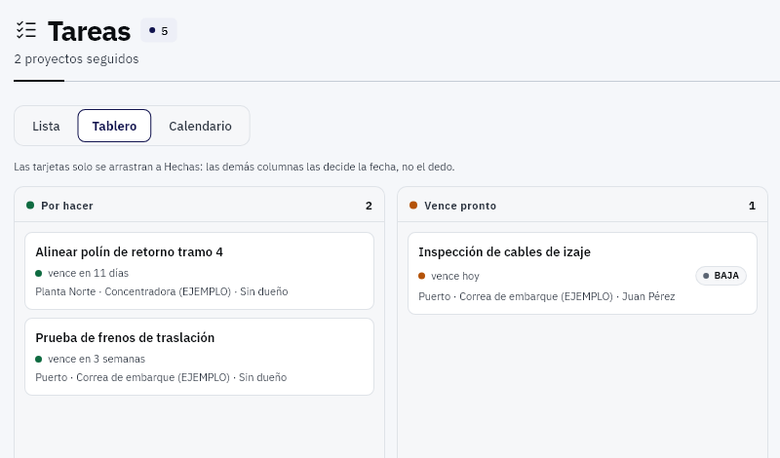
The maintenance that is due becomes a task with an owner
- Who does it today
- Nobody writes it. It is born when the plan enters its warning window —seven days, or whatever the company sets— as the unit’s record is opened.
- What is left
- The task with its owner and its due date, and the notice to the owner, queued at birth and delivered by grouped email at the frequency that person chose. If the task for that maintenance already exists, another one is not born.
- 03
Everything ever done to the unit, on a single sheet
- Who does it today
- Nobody builds it: it is assembled from the records already filled in on that item.
- What is left
- The history per unit, newest to oldest, with who filled in each one. What was deleted does not count as history, and restoring it brings it back on its own.
- 04
The unit that cannot be operated, said where people look
- Who does it today
- The supervisor who marks it out of service, and the operator who does the pre-use check before moving the machine.
- What is left
- The mark with its date, its written reason —there is a minimum: «broken» does not pass— and the name of whoever set it. While it stands, no work is loaded onto the unit, and not even the pre-use check lifts it: it has to be removed by hand, and that leaves a trace.
- 05
The machine on the way out and the machine on the way back, field against field
- Who does it today
- Whoever hands over and whoever receives, each at their moment.
- What is left
- The two photos of the same field side by side and the list of what changed. If somebody handed over a machine that had already been handed over, it is written down who forced it and over what.
What a maintenance plan has to be able to show
The rule is not satisfied with having the plan: it asks for up-to-date records, which the Service may request at any time. Two of these three rows come from the mining regulation, which is where it is written in most detail; the third applies on any site.
| What the regulation requires | What evidence PAIR produces |
|---|---|
| Supreme Decree 132 art. 410 Maintenance plan Up-to-date records that the Service may request at any time. | Every unit with its plans, its cadence and its next date on its own record, and below it the service history with everything that was done to it, by whom and when. |
| Supreme Decree 132 art. 39 Start-of-shift verification Every worker verifies, at the start of their shift, that the equipment, machinery and control elements they are going to work with are in good working order, and reports defects immediately. | The pre-use check at the cadence the company chooses —per day, per twelve-hour shift or per eight-hour shift—; and when the company also declares which of its forms is the pre-use check, no other form can be filled in on a unit without a current pre-use check until it is done. |
| DS 44 art. 72 Evidence of preventive management Record and back up, documentarily and reliably, all information linked to the management of occupational risks, and keep it preferably in electronic format. | Scheduled maintenance is born as a task with an owner and a due date, and is closed by writing what was done. The evidence comes out of the work, not out of a separate exercise. |
The bodies named are the regulators. PAIR neither represents them nor carries their endorsement.
What you start with
If your fleet’s schedule is in an Excel file and the pre-use check is a laminated sheet inside the cab, that is exactly the material. They get digitised as they are.
- Scheduled maintenance plan, with its cadence in days and its owner
- Mobile equipment pre-use check, per shift or per day
- Equipment handover checklist, with photos and signature
- Return checklist, compared field by field against the handover
- Fault report, with owner and deadline
- Out-of-service record, with written reason and who marked it
- Hour-meter or odometer reading, with range validation
- Unit service history: everything done to it, in order
Demo
Bring us the schedule for one of your units
The maintenance schedule and the pre-use check you use today, Excel included: in thirty minutes you see them on a unit’s record, with its next date and its owner.
- Would you rather look at the plans first? See pricing.
- Still have questions? Check the FAQ.